Tuesday, 31 January 2012

DIY Project


DIY PROJECT: RECYCLED PALLET VERTICAL GARDEN

Summer is waning, and since I am a diehard autumnal girl, I’d usually be very excited by now. But I have to be honest — this lush and vibrant pallet vertical garden is making me want to stay in summer for another month or two. There have been many pallet projects and many vertical garden projects, but none combine the two elements as well as this tutorial developed by Fern Richardson of Life on the Balcony and recreated by Steph of the local spoon. I like this so much, I might have to squeeze it in before I focus entirely on fall projects. — Kate
Have a DIY project you’d like to share? Shoot me an email with your images right here! (Low res, under 500k per image, please.)
There is nothing more adorable than little baby succulents. I happened to have a teeny porch desperately in need of love that didn’t get a lot of sun, so succulents were the perfect low-water, low-light choice. I also loved the idea of making something out of a pallet, one of those items you see everywhere — you have to wonder what happens to all of them, and I was excited to give one a purpose and home on my neglected porch. It transformed the space and was easy and lots of fun to make (the best part of all might have been my trip to the nursery where I could buy adorable baby succulents to my heart’s content). — Stephanie
Materials
  • a pallet (I found mine for free at a local garden store — mine measured 25 x 38 inches)
  • roll of landscaping paper (this can be quite expensive, but you don’t need as much as comes in a typical landscaping roll, so you might be able to find someone’s excess on Craigslist or at a local garden shop)
  • sandpaper
  • staple gun and staples
  • hammer and nails
  • potting soil (I used 2.5 cubic feet for the 25 x 38 pallet)
  • adorable succulents or other plants of choice
Instructions
1. Sand down any rough spots on your pallet. If the back of your pallet doesn’t have much support (mine was basically open on the back), find some scrap wood, roughly 3 to 4 inches wide and 1/4 inch thick (or the thickness of the rest of your supports) and cut it down to the width of your pallet. Using two nails on each side, add supports so they are roughly even down the back of your pallet.
2. Double or triple up your landscaping fabric and begin the stapling fun. Staple fabric along the back, bottom and sides of the pallet, taking care at the corners to fold in the fabric so no soil will spill out. (See photos for details on folding corners.)
3. Lay the pallet flat and pour potting soil through slats, pressing soil down firmly. Leave enough room to begin planting your succulents.
4. Begin planting, starting at the bottom of the pallet and ending at the top. Make sure soil is firmly packed in each layer as you move up. Add more soil as needed so that plants are tightly packed at the end.
5. Water your wall garden thoroughly and let it remain horizontal for 1 to 2 weeks to allow plants to take root. After 1 to 2 weeks, you can set it upright.
Note: Remember when you water to start at the top and water each subsequent section a little less, as your water will naturally seep through to the bottom-most plants.

Enjoy!

Tuesday, 24 January 2012

Plastic bottles pile up as mountains of waste


The biggest growth in bottled beverages isn't beer or soft drinks or juices. It's tasteless, colorless and sugarless water. And while that can mean fewer cavities and slimmer waistlines, it irritates Patricia Franklin to no end.
The director of a nonprofit group that promotes recycling, she spends her workday thinking about the bottles, cans and other container waste that most Americans take for granted.
The boom in plastic water bottles has her especially frazzled because while the recycling rate is extremely low, the demand from recyclers is actually quite high.
Franklin, who runs the Container Recycling Institute, doesn't blame individuals as much as what she feels is a recycling system that hasn't kept up with consumption patterns — especially when it comes to water.
Bottled water is the single largest growth area among all beverages, that includes alcohol, juices and soft drinks. Per capita consumption has more than doubled over the last decade, from 10.5 gallons in 1993 to 22.6 in 2003, according to the Beverage Marketing Corporation.
The growth has been even more impressive in terms of water bottles sold: from 3.3 billion in 1997 to 15 billion in 2002.
But most bottled water is consumed away from home, usually at a park, in an office or even while driving — areas where there's usually no recycling.

"The opportunities for recycling outside the home are minimal," Franklin says, "and therein lies the problem."
Bottles by the numbers
Only about 12 percent of "custom" plastic bottles, a category dominated by water, were recycled in 2003, according to industry consultant R.W. Beck, Inc. That's 40 million bottles a day that went into the trash or became litter. In contrast, the recycling rate for plastic soft drink bottles is around 30 percent.
The low water bottle recycling rate also impacts the overall recycling rate of all recyclable plastic containers. That's fallen from 53 percent in 1994 to 19 percent in 2003.

Plastics should be recycled so that less petroleum — a finite commodity — is consumed, Franklin says."The environmental impacts are in the drilling of the oil," she adds, noting that burning fossil fuel also releases gases that many scientists tie to global warming.
A second reason for recycling, Franklin says, is the litter factor. While plastic water bottles are not a significant percentage of overall waste, the empties are certainly all around us visually.
Thirdly, she says, is the fact that the domestic plastics recycling industry faces a shortage because so much is being exported to China for recycling there. That shortage has also led to fears that some companies will go bankrupt.
"There is a means to reclaim these bottles and use them to make new bottles and other products at home," Franklin says, "but they (recyclers) simply can't get enough of the containers to do it."
Strategies The Container Recycling Institute thinks a nationwide bottle deposit law would create the incentive to recycle, especially when it comes to plastic bottles, and ease the burden on taxpayers, who pay for cleaning up litter.

The purpose - where I start - is the idea of use. It is not recycling, it's reuse.
Issey Miyake


Tuesday, 17 January 2012

Bahamas on top 10 environment protection list!

Top 10 ethical destinations in the developing world

Every year, Ethical Traveler reviews the policies and practices of the world's developing nations, then selects the ten that are doing the best job of preserving their environment, promoting human rights and creating a sustainable, community-based tourism industry. By visiting these destinations, we use our economic power—our travel dollars—to support these countries.
In alphabetical order, the 2012 list:
Argentina
The Bahamas
Chile
Costa Rica
Dominica
Latvia
Mauritius
Palau
Serbia
Uruguay
How were these countries chosen? A research team first identifies the "best" tourism destinations, from Afghanistan to Zimbabwe. Next, using publicly available data, these countries are rated. (For more on the methodology, download the full report.) As Ethical Traveler researcher Natalie Lefevre points out, "None of these countries are perfect, but they deserve their spots—thanks to their effort to ensure that tourism has a positive impact on their country and their people."
Ethical Traveler notes some surprises in 2012. According to executive director Jeff Greenwald, "The steady trend we're seeing toward green practices and support for sustainable tourism—by governments and travelers alike—is a fantastic development, and shows a real coming-of-age in the international tourism community."

Tuesday, 3 January 2012

Top 5 Places Your Car isn't Welcome

Dear Friends,

I wish you a Happy, Healthy and Prosperous New Year.

If you were fortunate enough to receive a car for Christmas, please take note not to bring it here: (see below)
(It will now become evident to you that I'm back on my anti-vehicular traffic kick:)

As much as we all moan and groan about traffic jams and highway pile-ups, most Americans would be lost without their wheels. Can you imagine The Beatles singing, "Baby, you can't drive my car ... " ?
But for those who prefer hoofing to steering, here's a list of the top 5 places in America where wheels aren't welcome:
Monhegan Island, Maine: There are no cars allowed on this island off the coast of Maine, but you probably wouldn't need it anyway -- wee Monhegan Island is barely one-mile square. There are, however, 12 miles of "steep and strenuous" trails if you get restless.  The island is well-known as a prime fishing spot and has been a popular getaway for artists for decades.
Governors Island, New York: The only wheels allowed on this island are the ones powered by human legs. You can bring  your own via the free ferry, or rent a fancy QuadCycle once you arrive. The island was closed to the public until 2003, when the U.S. graciously sold it back to New York ... for a dollar.
Hike Inn, Georgia: They're not kidding around - to get to there, deep in the Amicalola Falls State Park, you actually have to "hike in." Two to four hours, to be exact. The Inn boasts clean linens, hot showers and home-cooked meals, but tech heads beware: There are no electrical outlets in the"'bunkrooms" and guests are requested "not to bring cell phones, beepers, pagers, laptops or other electronic devices."
Catalina Island, California: Just a ferry ride away from car-congested L.A., Catalina is paradise for those who prefer extremely "alternate" modes of transportation. Visitors can kayak, boat, zipline, parasail, helicopter, SNUBA, SCUBA, etc. -- anything but drive. Unless it's a golf cart, which are allowed in the main town of Avalon, but nowhere else.
Tangier Island, Virginia: On this island in Chesapeake Bay, three things are not allowed: cars, credit cards and alcohol. But before you cancel your reservations, there's boating, crabbing, biking, buggy tours, white sand beaches and more. Still not convinced? OK, you can rent golf carts here, too, if you really feel the need for speed.

Monday, 19 December 2011

Global Warming isn't just about warming!

Taken from an article by:
Matt Miller 
Director of communications for the Conservancy’s Idaho program.
As I traveled around the islands of Micronesia, I repeatedly heard people voice the same words: Moving is not an option.
The often-tiny islands of Micronesia—and other other Pacific chains—are populated by people with diverse cultures, cultures shaped by the land and water over the centuries and even millennia.
Today, with ocean levels rising and fish stocks disappearing, they are facing the most serious threat to their cultures, their traditions and, indeed, their lives. And moving is not an option.

Water Is Rising

I visited two islands in the Federated States of Micronesia, Yap and Pohnpei. On Yap, large stone “money”—huge limestone disks larger than I am—are still used for ceremonial transactions. Village life remains the central part of Yapese culture, and they still rely on reefs for their livelihood and sustenance.
On Pohnpei, I hiked around huge ruins—rivaling what I saw at more famous sites like Machu Picchu and Tikal—built on top of artificially constructed islands that extend a mile onto the reef. Nan Madol, as this area is known, began construction in 500 BC. Today, Pohnpeians practice a rich and traditional form of agriculture that incorporates seamlessly into the forest.
Thousands of islands in the Pacific are still home to thriving human communities. People have worked out ways to balance the reef and the forest. But forces beyond their communities could shape the future of these islands.
There’s an old cliché that there are no atheists in foxholesIn that same spirit, perhaps it could be said that there are no climate change deniers on islands.
As people in the United States seem intent on arguing whether or not climate change is real, islanders are seeing sea levels rise and land disappear.
A group of performing artists from Pacific Island nations recently toured the United States with their show, Water is Rising, telling stories of climate change as faced by their communities.
But the threats to islands don’t end with climate change: Coral reefs put fish on the plate for millions of people. But around Micronesia and other islands, fish stocks are being depleted.
No food. No land. No place to go.
The islanders deserve better.

Traditional Knowledge, Cutting-Edge Science

Fortunately, many communities are leading efforts to ensure that they will continue to have fish on their plates, viable jobs and places to live.
They value self-sufficiency. Willy Kostka, director of the Micronesia Conservation Trust, put it this way: “If I can keep the food relief agencies out of this region, then I’ve succeeded. If the Red Cross is here, we’ve lost. To me, conservationists are in the front line of self-sufficiency.”
Communities recognize the importance of protecting marine areas to sustain fisheries. A locally-led initiative called theMicronesia Challenge–which includes the five governments, local communities, and local and global organizations (including the Conservancy)—has a goal to protect to protect 30 percent of the near-shore marine resources across Micronesia by 2020.
These are the reefs that keep fish on the table.
Such local efforts are complemented by cutting-edge science, such as sophisticated models of climate change impacts that can direct conservation efforts and help communities plan for the future.
“We don’t take our islands for granted,” says Kostka. “Every day I feel so lucky I was born here on Pohnpei. I feel very privileged to live here.”
The people of Micronesia are hopeful. They believe they can shape their own future.
A difficult truth is that some factors—climate change, depletion of fisheries—are generated by countries far from the Pacific islands. The Micronesians are doing their part. Can we do ours?
There is much hope, but the water is rising. And moving is not an option.
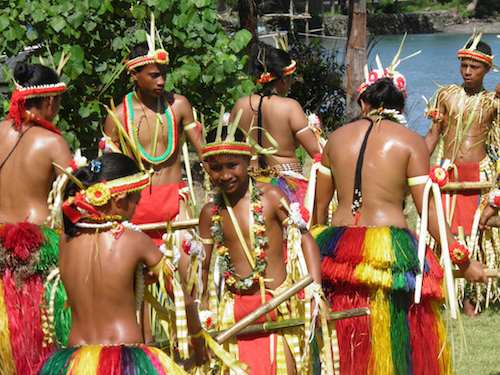
(Image: Villagers on the Pacific island of Yap perform the stick dance. Image credit: ©Matt Miller.)

Tuesday, 13 December 2011

Sykes Monkeys Photo Update


Two out of three were kind enough to take a break from snacking on some bananas to allow me to take their picture!

Tuesday, 6 December 2011

Ardastra- A Proud Sponsor of Bahamas Speedweek Revival!

The original Nassau Speed Weeks took place from 1954 to 1966 and featured  many of the great racing drivers of the period. Following a gruelling European season they took the opportunity to combine racing and relaxation in the sun. With today’s historic racers following the same pattern isn’t it time we went back ?

Iconic race cars such as Ferrari GTO, Birdcage Maserati, Chevrolet Corvette Grand Sport, Chaparral, AC Cobra and Ford GT40 were driven by stars including Roger Penske, Dan Gurney, Bruce McLaren, Innes Ireland, Ricardo Rodriguez, Mark Donohue and Stirling Moss. 
Evoking the era of the world famous Nassau Speed Weeks in the 1950s and 60s, the 2011 Bahamas Speed Week is a totally new and unique event offering luxurious experiences, exclusive hospitality and endless opportunities to have fun in the sun while the northern hemisphere is in the depths of winter.
With the support of the local Bahamian Ministry of Tourism, the BSWR team have put together a package for two people which includes: the shipping of your car, airport transfers, all accommodation, all lunches, evening buffets and dinners – including the amazing Graycliff, Lyford Cay and Charity Gala Ball, entry to the Fort Charlotte Hillclimb and Arawak Cay Sprint, all passes and VIP paddock hospitality plus a special 007 island tour and Heritage Nassau Car Licence Plate. 
Entry is open to Sports and GT cars of the period capable of running in a Tour Auto type road event plus classic road cars from 1954 to the present day and modern-day supercars.  All will participate in the competitive sections of the event with timing being optional for the latter two categories.  One of the unique elements of this week-long event is that it provides owners the opportunity to drive their race cars on public roads without fear of prosecution, as the local government is arranging for them to be temporarily road-registered whilst on the island and is providing special heritage number plates to mark the event.  Plate number 007 will be signed by racing legend Sir Stirling Moss and none other than 007 himself, Sir Sean Connery and will be auctioned for charity at the event’s Gala Banquet.